

The Battle of Arras
At the far end of the Saint-Sauveur network, George’s team was given the task of reopening a French sap which, according to the maps left by the engineers, lay beneath the remains of the Cambrai road. Within a few hours, they reached their objective, which appeared intact. From their position underground, the German shells thundered heavily overhead. The enemy had held its positions at that point on the front and continued its operations against the British trenches. The tunnellers plunged into the French tunnel to check its condition. Apart from a few fragile sections, its overall state was fairly good. New timbers were installed[1].
The German withdrawal had left two of the five tunnels at the far end of the Saint-Sauveur complex too short to reach the new enemy line—and extending them would have taken too long. The officers turned to old French workings, hoping to repurpose them as Russian saps, but found only one still usable. New galleries were started to fill the gaps, only for enemy bombardments to slow progress and damage I56, two of its entrances destroyed and needing to be rebuilt.[2] Increasingly frequent and now daily, the shelling no longer allowed any digging. Unable to complete the work in time, the officers decided to use only the three galleries unaffected by the German withdrawal: I57, I56, and I54 (Map 10). The men still had to fit them out and prepare the exits toward the enemy lines so that these three saps could form a strongpoint of the offensive.
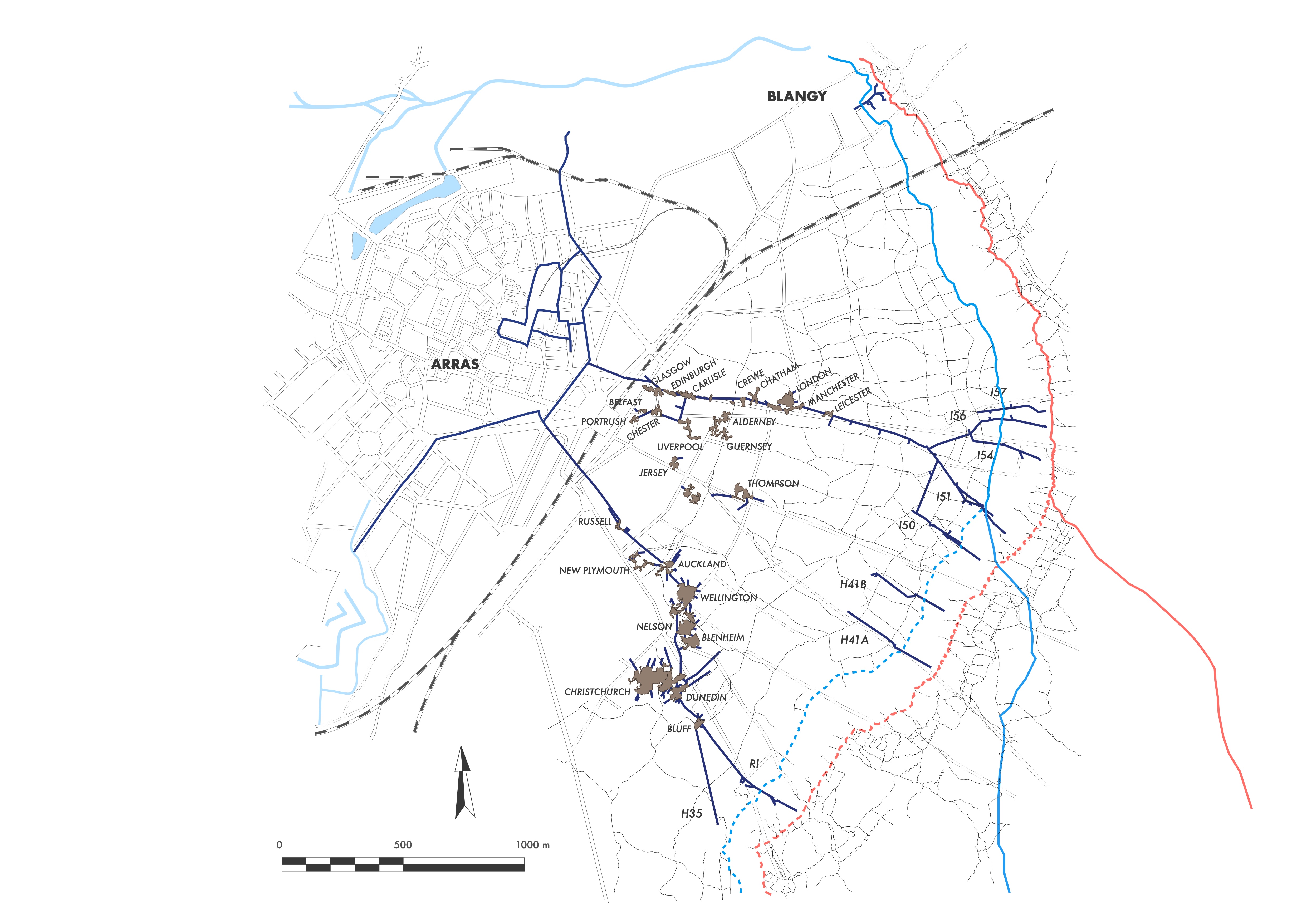
At Blangy, the rest of the company was still fully occupied with fitting out the underground complex which, as at Saint-Sauveur, was intended to bring soldiers directly into the enemy trenches (Map 10). From the main tunnel already driven, a branch was dug toward the front. By bad luck, it broke through via a small hole into a German sap. The tunnellers looked into the enemy network. Everything seemed quiet[3]. The hole was sealed up again, and a one-ton explosive charge was placed in the New Zealand gallery, ready to be fired at any moment. A new branch was opened from the main tunnel to bypass the enemy sap network, but it too broke into an enemy gallery[4]. That small opening was also concealed. Above ground, enemy fire was unrelenting. On the morning of 23 March, British artillery replied to the German guns but misjudged its aim—a heavy mortar round fell in No Man’s Land and the tunnel the New Zealanders were building collapsed beneath it. Four tunnellers and three Treillis were buried alive. A rescue tunnel was driven immediately alongside the collapsed gallery, and nine hours later the men were brought out without a single injury. They owed their survival to the air pipe, which the collapse had somehow left intact.[5] The tunnellers abandoned the damaged section and enlarged the emergency access, allowing them to communicate with the two branches already prepared. They hoped to take advantage of the—so far concealed—connection between their sap and the enemy’s so that, on the day of the offensive, British soldiers could enter the German underground system and thereby reach their trenches.
At Arras, the Ronville system was dropped from the attack plan. However, it could still be used to billet troops and conceal their mass arrival. Housing around 9,500 men was possible in this part of the underground complex. The largest of all the caverns, the Christchurch quarry, could alone accommodate more than 4,000 soldiers. The Saint-Sauveur network, made up of smaller cellars, could lodge only 2,000. In total, nearly 11,500 men could be billeted east of the city. A similarly large number would find space in the deep cellars around the squares and in the adjoining streets. The enemy withdrawal, however, had deprived the British of the surprise effect they had wanted to give their attack along the front east of the town. Most soldiers would have to face the dreadful crossing of No Man’s Land. To support the smaller forces that would pass into the enemy lines from the Russian saps, the tunnellers prepared machine-gun nests and trench-mortar positions from the three tunnels at the far end of the Saint-Sauveur network. Holes were drilled in the ceilings of I56 and I54. Explosive charges placed in these openings would, once fired, create a communication trench. This work was carried out while raids and bombardments continued on the surface[6]. I56 suffered new damage. The explosion of a British trench mortar blew in the gallery, which the tunnellers had to repair at once. The old saps I50 and I51, abandoned after the German withdrawal, were opened to the surface in the new British trenches laid out in the former No Man’s Land.
Lofty and Sharkey were installing anti-gas doors throughout the Arras underground complex—110 of them in all, fitted at every quarry and tunnel entrance to block the spread of chemical weapons through the system. From 3 April onward, the entire underground city was supplied with electricity, with continuous lighting provided[7]. On that occasion, an infantry unit from the 12th Division carried out a movement test through the quarries. Starting from the cellars off the Grand Place, it managed to reach the front lines without difficulty in one hour. Most of the tunnellers who were working on the front were recalled to the company’s rear billeting area at Agnez-lès-Duisans, a village west of Arras, during the night of 3–4 April. Their work was now finished. British artillery began a major bombardment on 4 April at 6:30 a.m.[8] The German trenches were shelled, pounded by mortars, machine-gunned, and gassed without respite. The enemy now had no doubt that an offensive was about to take place.
On 8 April 1917, preparations accelerated. At Blangy, the tunnellers cleared away the chalk blocks that concealed the breach into the German gallery. Only a thin partition was left. Beneath the road to Cambrai, the men continued installing explosive charges. In the evening, the British fired chemical shells into the enemy trenches. A few detonated near the heads of the I57 and I56 galleries, flooding them with gas. The tunnellers had to withdraw. With the offensive scheduled for the following morning, the two Russian saps were inaccessible. Shortly before midnight, a few sappers were ordered to remove some mines placed in the ceilings and to open the apertures to the surface. They tried to create a natural airflow to drive out the deadly gases. The operation worked, and the tunnellers were able to access the two saps again a few hours before the offensive began.
On the morning of Easter Monday, 9 April, only the 2nd and 3rd sections were at work from 4:30 a.m. The rest of the company was quartered at the camp at Agnez-lès-Duisans. Most of the tunnellers had been assigned beneath Arras to monitor, inspect, and repair the galleries, the quarry ceilings, the exits to the surface, the anti-gas doors, and any other issues in the sewers and cellars. A small group had been sent to the front. All the machine-gun and trench-mortar positions in each gallery beneath the road to Cambrai were opened.[9] The guns and ammunition were installed. At the same time, the three exits into No Man’s Land were cleared.[10] The weather was harsh, and the cold seeped into the tunnels. The sky had clouded over during the night. It had first rained, before snow began to fall. Along the front, British soldiers massed in the trenches from Vimy in the north to Croisilles to the south-east of Arras. Some were already crawling out into No Man’s Land.[11] Others took up position in the Blangy underground system and at the entrances to I57, I56, and I54 at Saint-Sauveur. The tunnellers stood ready to fire the various charges.
At exactly 5:30 a.m., the explosion of the mine at Blangy, along with the detonation of the charges placed in the ceilings of I56 and I54, gave the signal for the soldiers in the trenches to surge toward the enemy lines. At Blangy, the tunnellers opened the access into the German underground system, and the first troops went in. The mine blast in the other part of the tunnel had drawn the enemy farther north, so the British were able to enter the saps and quickly make their way back up to the surface. From one of the exits, a group of tunnellers began digging a trench toward the crater formed by the mine explosion to make it easier for men to move toward the enemy front.[12] At Saint-Sauveur, the tunnellers faced greater difficulties. The charges that were meant to collapse the two southernmost saps produced two trenches larger than expected. In I56, they created a crater 3 metres deep, 9 metres wide, and 15 metres long. The blast in front of the German trenches, more violent, destroyed the sap over a length of 4.5 to 6 metres. In I54, the trench extended for nearly 50 metres, with a width of 13.4 metres and a depth of 3.65 metres. The accesses from the underground were unusable. The tunnellers had to break through again. Because the work was more extensive, they lost time and delayed the opening of I57. Thirty minutes after the attack began, this was the first to be cleared. But it was already too late. The success of the surface assault was such that the Russian saps were no longer necessary. The tunnellers nonetheless continued their mission. At 6:15 a.m., they opened an access to the surface from I56, and the long crater was connected to the German trench that had just been captured. The same operation was carried out in two hours on the I54 side, but the access was never used. British troops had already achieved a breakthrough on the Arras plain.
With the start of the Battle of Arras, the men of the 2nd and 3rd sections inspected every corner of the galleries and quarries, gathering up belongings left behind or forgotten by the soldiers who had gone over the top—or who were perhaps already dead.[13] They also kept watch over the underground city, especially the electrical network. The various generators supplying power were regularly refuelled with petrol so they could run continuously, particularly on the Saint-Sauveur side and in the underground hospital. The 1st and 4th sections were sent to the Cambrai road, a major route to the fighting, to begin repairing it. The tunnellers, who for the moment were no longer of any use underground, were therefore assigned engineering works. Like many of their comrades, Lofty and Sharkey worked in the snow.[14] To the bitter cold was added the discovery of a German mine beneath the road on 11 April.[15] The charge lay at the end of a long gallery whose entrance was in the former German front line. With great caution, several tunnellers went into the underground system and found nearly three tons of explosive, which they defused without difficulty.
On 12 April, all the sections were brought together on the Cambrai road. Some tunnellers, who had been working without pause for several days, were sent to rest at the rear billets. For the others, work began at 5 a.m. and lasted until 9 p.m. Snow was still falling heavily and, despite the very harsh conditions, the old road surface gradually took shape again. The Germans continued to bombard the area fiercely, to the point that a British soldier had dotted the route with small, humorous signs. When George used the road from Arras that very morning, he first saw a sign that read “Run Here”, then another a little farther on: “Run Faster”, and as he neared the junction with the Feuchy road—the point closest to the fighting—a final one read “Go for your life”[16]! The message, however, was not just a joke and had to be taken seriously. British troops of the 12th Division were now more than six kilometres from Arras and had captured the village of Feuchy, north of the Cambrai road, on the evening of 10 April. However, the Germans still controlled many stretches of their trenches between Feuchy and the road where the New Zealanders were working. The area therefore remained a target for intense fire. On 13 April, Lieutenant Metcalfe was killed by shell splinters at the crossroads of the Cambrai and Feuchy roads. Work nevertheless continued, and the snow gave way to rain. The next day, George was sent on leave, but the unfortunate man twisted his ankle as soon as he disembarked on the other side of the Channel and was sent to hospital.
British soldiers captured the village of Monchy-le-Preux, about ten kilometres east of Arras, but the main road was still being heavily shelled. On 19 April, the explosion of a shell killed Sapper Fahey and sent Sapper Adams to hospital. The Germans intensified their bombardment the following day and kept it up until 22 April, wounding another tunneller. They attempted to retake Monchy-le-Preux, but the Royal Newfoundland Regiment held its positions until reinforcements from the 29th Division arrived. A kilometre farther south, men of the 30th and 50th British infantry divisions attacked on 23 April and managed to push forward to the village of Guémappe at the cost of heavy losses. They forced the enemy to fall back out of firing range of the stretch of road where the New Zealanders were working. Weather conditions improved markedly, and fine sunny days at last accompanied the tunnellers[17]. Repairs to the road progressed faster, all the more so because construction machinery was made available to the company.
As the German lines fell back, the grounds of the Château d’Immercourt at Saint-Laurent-Blangy yielded a discovery long sought. There lay the grave of Lieutenant Durant and Sergeant Pownceby, both men who had vanished during the British assault of 14 September the year before. The enemy had tended the burial with respect, maintaining it carefully and marking it with a white cross bearing the words: “Here lie four brave Englishmen: Lieutenant Durant, two non-commissioned officers, and a soldier”[18]. When word reached Jim—who had by then returned from hospital and had been among those who went forward that night when the two men disappeared—he came at once to the grave. There he stood in quiet remembrance, paying his respects with profound emotion to men with whom he had fought.
The British troops were no longer gaining ground. For lack of reinforcements, the initial success of the battle did not last. New British lines were established at the foot of the hill, east of Monchy-le-Preux. The company’s officers were frustrated: the immense work beneath Arras had not delivered the impact they had hoped for. The soldiers had had to cross No Man’s Land, except in a few parts of the front such as at Saint-Sauveur, Blangy, and Vimy. Even so, the offensive succeeded in putting Arras, which had been under bombardment since October 1914, out of range of enemy fire. Yet the 20,000 prisoners and the seizure of a vast stockpile of weapons had to be weighed against the losses that followed 9 April. The fighting, which lasted only 39 days, cost the lives of more than 4,000 men per day. On the French side, the offensive launched on 16 April 1917 along the Chemin des Dames was an immediate failure. The advance that was supposed to make it possible to seize Laon, about twenty kilometres behind the German lines, did not even break through the enemy trenches. Losses were catastrophic and led to mutinies.
The immense underground shelter created by the New Zealanders was only the first work in a long series that followed the Battle of Arras. Fortifying the new British positions was essential now that the two sides found themselves entrenched face to face in front of Monchy-le-Preux. The New Zealanders had not planned to resume the fighting underground. They were not the only ones. Most members of the tunnelling companies on the Arras front had believed that the offensive would restore mobility and perhaps even bring the first signs of the end of hostilities.[19] The establishment of the new front lines, now held at a distance from one another, did not encourage the tunnellers to resume the struggle below ground. The Battle of Arras thus marked the end of underground warfare on the front around the city and, farther north, at Vimy.
At the beginning of May 1917, part of Section 4 began converting newly uncovered cavities into billets: at the Feuchy chapel, beneath the crossroads of the Cambrai and Feuchy roads, and at the place known as Les Fosses, beneath the ruins of a farm along the Cambrai road, near Monchy-le-Preux. The men no longer returned to Arras and were housed close to the front in shelters abandoned by the Germans, while the rest of the company completed the repair of the Cambrai road. The tunnellers had already rebuilt more than 12 kilometres of roadway, including nearly eight suitable for light vehicles and five for heavy vehicles. The final work was carried out during May, as little by little all the men were transferred to the front to begin various underground works. Although restoring this major communication route to the front had not been intended primarily to benefit the tunnellers, it was nonetheless important. This straight road would facilitate the transport of equipment to the different construction sites of the tunnellers’ future underground works. The company was in fact preparing to take over a sector of almost 10 square kilometres, stretching between the villages of Gavrelle to the north and Guémappe to the south, from Monchy-le-Preux to the east and Tilloy-lès-Mofflaines to the west; the Scarpe dividing the work zone in two at the level of the village of Fampoux. Given the extent of the work area and the rapid multiplication of underground installations, the officers chose logistics that were as precise as they were efficient.
Chapter 10
Still DiggingNotes
- 1.
The National Archives United Kingdom, WO 95/407, New Zealand Tunnelling Company War Diary, 19 March 1917, “In front line a small tunnell has been made by the French under the Cambrai Road. Started to-day opening this out and re-timbering.”
- 2.
Ibid., 20 March 1917, “2 entrances to I.56 were blown in during Artillery strafe today and had to be repaired.”
- 3.
Ibid., 17 March 1917, “I70a broke into Hun Gallery, only a small hole made but a box was observed in his gallery”.
- 4.
Ibid., 20 March 1917, “Holed through into Hun Gallery”.
- 5.
Ibid.
- 6.
Ibid., 29 March 1917, “Work delayed I 54 and I 57 by our infantry raiding and the resultant strafe.”
- 7.
Ibid., 4 April 1917, “Started supplying full electric light in the sewer, St Sauveur system and Casualty Clearing Station Cave […] Running and maintening the electric light systems and emergency oil-lights in the complete RONVILLE, ST SAUVEUR and SEWER Systems, also in the Casualty Clearing Station Cave.”
- 8.
Jonathan Nicholls, Cheerful Sacrifice, The Battle of Arras 1917, Barnsley, Pen & Sword Military, 2005, p. 32, “Supported by thousands of light, medium and heavy trench mortars together with harassing heavy machine-gun barrages, it would be the greatest artillery bombardment the world had ever seen.”
- 9.
The National Archives United Kingdom, WO 95/407, War Diary…, op. cit., 9 April 1917, “The machine gun emplacements in I 70, I 57, I 56 and I 54 were opened up at about 4-30 a.m.”
- 10.
Ibid.
- 11.
Jonathan Nicholls, Cheerful Sacrifice…, op. cit., p. 75.
- 12.
The National Archives United Kingdom, WO 95/407, War Diary…, op. cit., 9 April 1917, “An other party started digging a trench from the exit from the left of I 70 to the crater blown by the Mine.”
- 13.
Ibid., 10 April 1917.
- 14.
James Campbell Neill, The New Zealand Tunnelling Company, 1915-1919, Auckland, Whitcombe & Tombs, 1922, p. 82, “… bitterly cold weather snow and mud made the job anything but pleasant.”.
- 15.
The National Archives United Kingdom, WO 95/407, War Diary…, op. cit., 11 April 1917, “Mine under ARRAS-CAMBRAI road was unloaded.”
- 16.
James Campbell Neill, The New Zealand Tunnelling Company…, op. cit., p. 82.
- 17.
Ibid., p. 83, “Towards the end of April and the beginning of May the weather became fine and even hot, spring came with a rush of growth and blossom wonderful to our southern eyes, and a further advance pushed the Hun artillery back out of all but long range fire on the road.”
- 18.
The National Archives United Kingdom, WO 95/407, War Diary…, op. cit., 22 April 1917.
- 19.
Herbert W. Graham, The Life of a Tunnelling Companies, Being an intimate Story of the Life of the 185th Tunnelling Company Royal Engineers, in France, during the Great War, 1914-1918, Hexham, J. Catherall & Co., 1927, p. 182-183.
How to cite this page
Anthony Byledbal, “Chapter 9: The Battle of Arras”, in Kiwis Dig Tunnels Too, New Zealand Tunnellers, 2017. Available at: