


The Pontoon Engineers of the North
Lofty and Sharkey set about the final safety work on the Noyelles-sur-Escaut bridge—built in just 25 hours—while below them the dark waters of the canal moved slowly. Beside them, the group of men from the 565th Army Troops Company, who had already taken part in the erection of the Havrincourt bridge, continued the on-the-job training of the tunnellers[1]. On a rather cold night that forced the men to turn up their coat collars, Lofty and Sharkey, like their comrades, worked amid the constant back-and-forth of vehicles, the engine noise echoing all around. When the bridge was opened to traffic on the evening of 11 October 1918, the troops of the XVIIth and VIth Corps were trying to make up their delay compared with their counterparts in the rest of the Third Army, already positioned along the River Selle, a few kilometres further east. Although temporary footbridges had indeed been put in place along the canal to get men across on foot, they did not allow heavy equipment to pass. The Noyelles-sur-Escaut bridge was therefore part of a wider set of “heavy-traffic” crossings intended to make it possible to continue the attack (Map 11). At Masnières, a village downstream, the British engineers, assisted by a small group of New Zealanders, opened one of these other crossings on 12 October[2]. The XVIIth and VIth Corps finally reached the Selle the following day.
The company was then sent to Cambrai, where Canadian engineers had already put several bridges in place around the city. Two of them had been installed at Escaudœuvres and one at Morenchies, north of Cambrai, to cross the Escaut Canal. Another footbridge had been placed on the Douai–Cambrai road, again to span the same obstacle, to the north-west of the city. All these bridges were gradually replacing the floating footbridges that had been used temporarily during the first days of the offensive. Cambrai was a strategic point because it lay at the junction of the First and Third British Armies. Above all, it was an essential node in the transport axis towards the theatre of operations: several routes led directly from the region’s largest centres such as Arras, Douai, and Bapaume. Captured a few days earlier, the city of Cambrai assigned several missions to the tunnellers. While one part of the men began, on 20 October, the construction of a bridge on the Arras–Cambrai road, the rest of the company went in search of mines left by the enemy[3]. Their prospecting proved fruitful, since several charges were defused without great difficulty. Almost the entire unit was in the city, except for a group of 40 tunnellers, including George, still at Havrincourt working on restoring the banks of the Canal du Nord[4]. The bridge on the Arras–Cambrai road caused the New Zealanders no problems, as they were now working on their own. The British engineers had returned to their own units, leaving the tunnellers to handle the work independently. At the end of October, a second bridge was repaired over the railway lines leading to the station (Map 11). The western side of the city opened up, linking the Arras and Bapaume roads into the city centre.
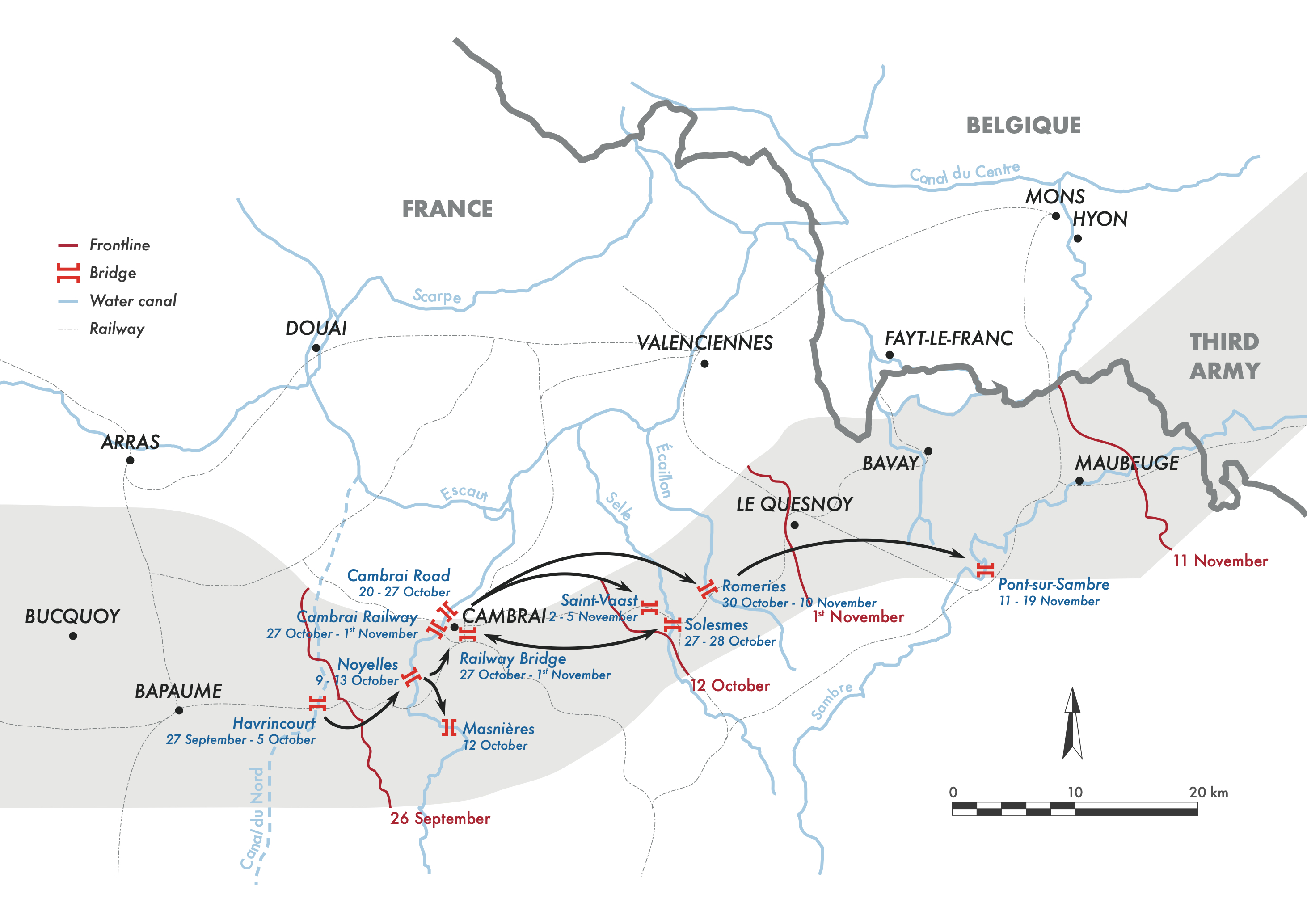
The company’s Section 4 pushed further forward, close to the front line, and reached Solesmes, a village about twenty kilometres east of Cambrai, on 27 October. It began work immediately to build and install a bridge over the River Selle (Map 11). The troops of the British Third Army were about ten kilometres further east and were approaching the fortified town of Le Quesnoy via the Écaillon valley. Several small watercourses ran through the area: the Harpies and Saint-Georges streams, and the Écaillon River. The tunnellers were not the only ones at work. Taking advantage of the Third Army’s pause—its troops exhausted after repeated night marches and daytime fighting—all engineer units were employed in reconnecting this fragmented, thoroughly disrupted territory[5]. Every bridge built from the rear—such as those at Cambrai erected by the tunnellers—right up to the front line mattered for bringing up ammunition, weapons, rations, and reinforcements. The Solesmes bridge opened the way towards the Harpies stream, where the construction of a small culvert at Romeries was also assigned to the New Zealanders (Map 11). However, the Section 4 was not tasked with that work and was replaced nearer the fighting by a group of their comrades coming from Cambrai. The riverbed caused some stability problems when installing the wooden posts that would support the bridge deck. The work fell several days behind schedule as the Third Army resumed its advance on 4 November; the attack was a success.
At Cambrai, the rest of the tunnellers rebuilt a railway bridge, opened immediately to reconnect the Bapaume–Cambrai railway line to the junction south of the town, towards Bertry–Bussigny. This line ran directly down to the town of Saint-Quentin, in the sector of the British Fourth Army. Its importance, however, lay further afield, to the east, towards Maubeuge. The track could in fact be extended as far as Solesmes and Romeries. Developing this axis was essential as the troops were at the gates of Le Quesnoy. The New Zealanders were therefore engaged in erecting another railway bridge at Saint-Vaast, a few kilometres west of Solesmes, on 2 November[6]. Three days later, the bridge deck and the rails were laid (Map 11). The clearing and repair of the Marcoing–Cambrai line by British engineer units also made it possible to link the rear areas from Havrincourt up to the front lines. However, trains were slowed by the single track from Marcoing to Cambrai, which was not doubled until 7 November. British troops had already pushed into Rosinval and, above all, into Ghissignies, Louvignies, and Jolimetz, south of Le Quesnoy. Encircled, the fortified town fell to the New Zealand Division late in the afternoon of 4 November[7].
When the Romeries culvert was finally completed on 10 November, British troops were already far away and had retaken the town of Maubeuge, near the Belgian border. The enemy was no longer offering any real resistance. Cavalry and the cyclists’ corps, sent ahead as scouts, found nothing but abandoned villages[8]. The unit headquarters, together with the 2nd and 3rd sections, set off for the village of Pont-sur-Sambre, 25 kilometres east of Romeries. A new footbridge was to open access to the southern part of the Maubeuge area, cut through by the River Sambre (Map 11). On the morning of 11 November, the tunnellers carefully examined the banks and the riverbed in order to prepare the construction work. George, who had finally returned from Havrincourt, was ordered, like a few of his comrades, to cut timber in the Forest of Mormal, needed for the new structure. The 1st and 4th sections, for their part, were employed laying a wooden plank road at Solesmes to allow vehicles to pass over broken ground. The company was informed that the Armistice had been signed at dawn. But the ceasefire, which took effect at 11 o’clock, left the tunnellers in a profound silence, happy, yet unable to take in the magnitude of the news[9]. Mechanically, Lofty, Sharkey, George, and the rest of the men returned to their tasks. And almost automatically, the pace of work became sustained again, as if the fate of the armies still depended on everyone’s efforts.
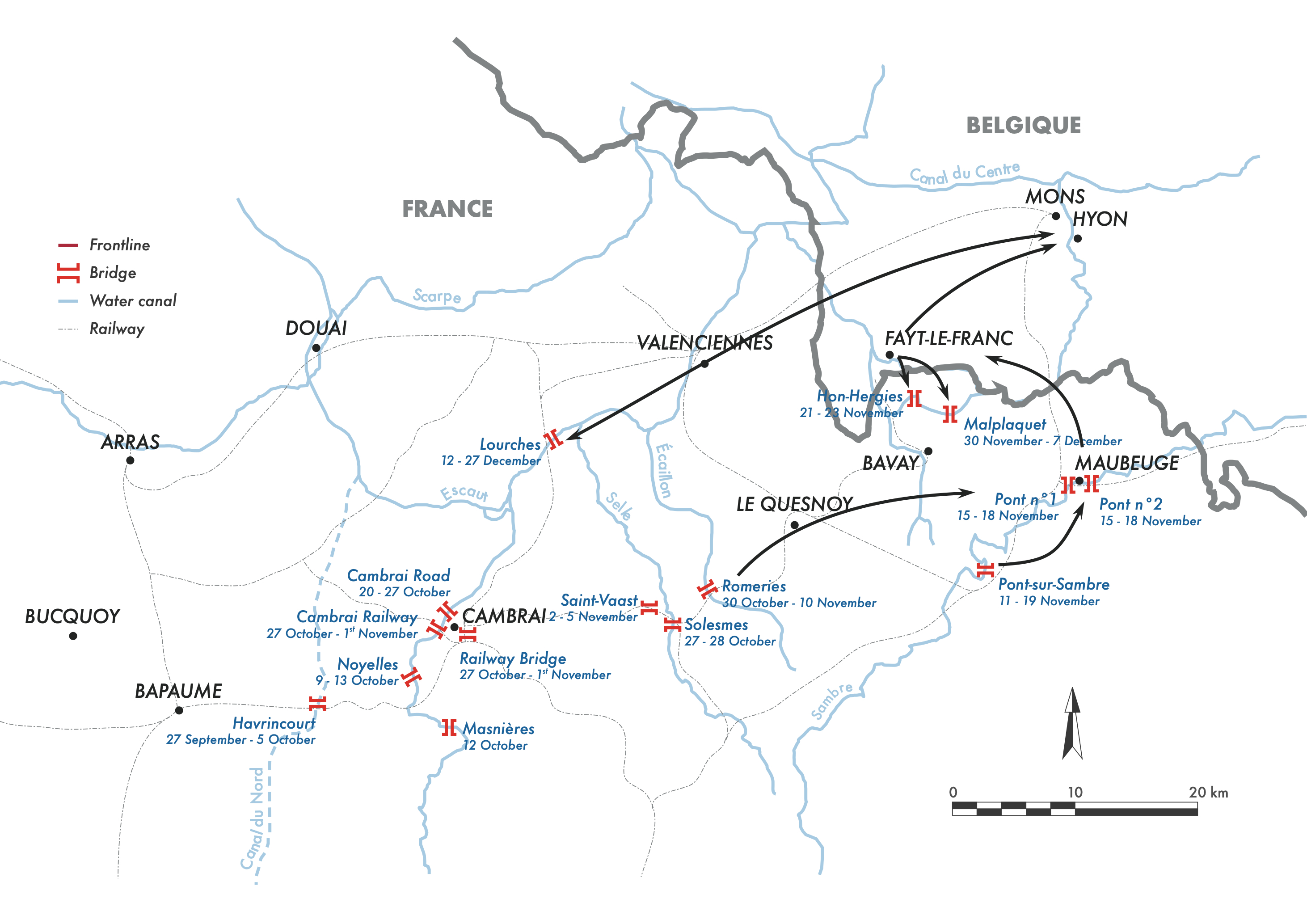
Once the work at Solesmes was finished, Lofty and Sharkey’s section, together with the Section 4, was sent to Maubeuge—about ten kilometres north-east of Pont-sur-Sambre—three days after the Armistice. Already, civilians were running up along the road as they passed, shouting with joy. At the entrance to the town, more and more people were crowding together to catch sight of the soldiers in uniform. Others pressed in behind them, waving small French tricolour flags and Union Jacks held high above their heads[10]. Despite the fleeting euphoria, Lofty felt pity for these people who, after fleeing the fighting, were coming back home, hauling a few personal belongings on every kind of vehicle imaginable. Some families had pitched tents around a part of the town that was almost inaccessible—encircled by the 17th-century ramparts from east to west, and blocked to the south by the Sambre. Only a makeshift wooden footbridge, floating on barrels, provided a perilous access for those who dared to use it. The New Zealanders had been tasked with replacing it with two bridges: one spanning the river, and the other installed across the fortifications’ ditch[11]. The Section 1 was assigned to erect Bridge No. 1, a steel-girder footbridge, assembled in the same way as the Havrincourt and Noyelles-sur-Escaut bridges, to cross the Sambre. The entire Section 4 took charge of Bridge No. 2, built entirely of wood, providing access to one of the entry gates into the fortified part of the town—the Porte de France (Map 12).
Learning the news, many refugees flocked near the construction sites. Several tunnellers volunteered to direct traffic as a delivery of equipment approached, pushing back the civilians crowded along the streets and keeping them at a distance from the operations[12]. At the site of Bridge No. 1, Lofty and Sharkey, accompanied by a few comrades, were clearing the riverbank and its surroundings, hemmed in between the tall red-brick houses lining the street and the river—mere empty shells, looted and left open to the elements. Other companions were already unloading the equipment. The lack of room to manoeuvre made the task anything but easy. Assembly of the metal framework began the next day, while down in the ditch below the Porte de France, the men of Section 4 were still only at the stage of unloading the wooden beams, delivered by cart from Marpent, about ten kilometres west of Maubeuge. To make up for the delivery difficulties, the tunnellers showed real resourcefulness to get the erection of Bridge No. 2 underway. The Section 4 did not want to fall behind. A challenge had in fact sprung up between the two sections of the company, who enjoyed competing to see who would finish their bridge first. The tunnellers therefore used a stock of planks discovered in a warehouse abandoned by the Germans.
On 17 November, the wooden piles were in place in the ditch. The bridge deck was being installed to open access toward the Porte de France. Above the Sambre, Lofty and Sharkey’s section was pulling the metal structure in order to connect to the opposite bank. At both sites, the work seemed to be at the same stage. The delay of the Section 4 was no longer as significant, and the wooden bridge might well be finished before the steel one. Refugees were fascinated by these operations. Many onlookers watching the New Zealanders erect the two footbridges fuelled conversations across the town and in the first cafés that had reopened[13]. The next day, both bridges were almost finished. Each of the two sections worked relentlessly to beat their rivals. At the site of Bridge No. 1, Lofty, Sharkey and their comrades were laying the roadway surface and securing the approaches. On Bridge No. 2, the same tasks were underway. In the end, Bridge No. 1 was finished by 6 p.m. and, two and a half hours later, Bridge No. 2 was opened to traffic[14]. The steel bridge won out over the wooden bridge. On the morning of 19 November, a crowd gathered spontaneously near the two bridges, applauding the tunnellers as they packed up their equipment. The mayor of Maubeuge, Jules Walrand, came to visit both sites and offer his warmest thanks to the men of the company for the speed with which the mission had been completed. He wanted to present the unit with the city’s medal but, for lack of time, the official thanks could not be organised[15]. Early the next morning, the two sections left Maubeuge and joined the other half of the company as it marched toward the Belgian village of Fayt-le-Franc, a few kilometres from the French border.
George’s section and Section 3 had in fact completed their work at Pont-sur-Sambre. Opening up the territory south of Maubeuge, the footbridge was still being used by British troops who continued to occupy the area, since the Armistice had only been signed for 30 days, renewable. Leaving French territory, the New Zealanders were transferred from the VIth Corps of the Third Army to the XXIIth Corps of the First Army, which had taken Mons on 11 November. However, George and his section immediately returned to France to build a culvert over the river L’Hogneau at Hon-Hergies, a village north of Bavay. As soon as the work was finished and after a few days of rest, they were sent to the hamlet of Malplaquet, in the neighbouring village of Taisnières-sur-Hon, for the same task (Map 12). The rest of the tunnellers were more versatile than ever. The end of hostilities turned them into full-fledged engineer troops. Restoring roads, searching for any mines the Germans might have left under routes of communication, and building bridges and culverts became their main missions around Mons. The pace of work was now less intense, and several rest days were granted. The tunnellers even played at being tourists, visiting the town of Mons in small groups in the late afternoon[16]. But minds were fixed on the date of return to New Zealand. On 30 November, their superiors informed the men that they would be demobilised as soon as possible. Some, sent on leave, did not return to the unit and left the service once their week of rest ended. Others, having served the longest, were simply released[17]. Yet the company’s ongoing workload did not herald any further transfers of tunnellers to Great Britain. Lofty, Sharkey, George and their comrades therefore continued their tasks without complaint.
Almost the entire unit took part in draining floodwaters, following the destruction of a viaduct by the Germans in the final days of the war, at Spiennes, south of Mons. George’s section, having finished the work at Malplaquet, left for Lourches in northern France, between Douai and Valenciennes, to work on one last bridge: a railway footbridge to be installed over the Scheldt Canal (Map 12). However, in Belgium as in France, the tunnellers’ ranks were thinning once again with the departure of married men in early December. In a month, the company’s strength fell from 437 to 370 tunnellers—too few for the New Zealand government, which, since 18 November, had been pressing the War Office in London to grant the immediate demobilisation of the entire unit.
Chapter 15
The Company DemobilisedNotes
- 1.
The National Archives United Kingdom, WO 95/407, New Zealand Tunnelling Company War Diary, Notes from the Chief Engineer of the Third Army regarding the construction of the Noyelles-sur-Escaut bridge, October 1918 annex, p. 7, “A party of the 565 A.T.Co.R.E. were attached for duty more for experience than anything else”.
- 2.
Ibid., Weekly Reports from 10 to 16 October 1918.
- 3.
James Campbell Neill, The New Zealand Tunnelling Company, 1915-1919, Auckland, Whitcombe & Tombs, 1922, p. 131.
- 4.
The National Archives United Kingdom, WO 95/407, War Diary…, op. cit., 16 October 1918.
- 5.
James E. Edmonds, Official History of the Great War, Military Operations France and Belgium, 26th September - 11th November: The Advance to Victory, Uckfield, The Naval and Military Press, 2010 (orig. ed. 1925), vol. 5, p. 386.
- 6.
The National Archives United Kingdom, WO 95/407, War Diary…, op. cit., 2 November 1918, “Work commenced at 6 a.m. on Railway bridge at St. Vaast.”
- 7.
James E. Edmonds, The Advance to Victory…, op. cit., p. 481.
- 8.
Ibid., p. 529.
- 9.
James Campbell Neill, The New Zealand Tunnelling Company…, op. cit., p. 135, “… a deep wonder kept each man silent, that he should have come to the finish unscathed”.
- 10.
Ibid.
- 11.
The National Archives United Kingdom, WO 95/407, War Diary…, op. cit., 15 November 1918.
- 12.
James Campbell Neill, The New Zealand Tunnelling Company…, op. cit., p. 136, “Unable to convey their queer vehicles and goods across the river these poor people camped in ever increasing numbers in the sodden fields, waiting patiently till the bridges could be replaced.”
- 13.
Ibid.
- 14.
The National Archives United Kingdom, WO 95/407, War Diary…, op. cit., Weekly Reports from 13 to 20 November 1918.
- 15.
James Campbell Neill, The New Zealand Tunnelling Company…, op. cit., p. 137.
- 16.
The National Archives United Kingdom, WO 95/407, War Diary…, op. cit., 26 November 1918, “… two lorry loads are being sent every afternoon to visit MONS.”
- 17.
Christopher Pugsley, On the Fringe of Hell, New Zealanders and Military Discipline in the First World War, Auckland, Hodder & Stoughton, 1991, p. 290, “first to join, first back”.
How to cite this page
Anthony Byledbal, “Chapter 14: The Pontoon Engineers of the North”, in Kiwis Dig Tunnels Too, New Zealand Tunnellers, 2017. Available at: