


The Tunnellers from the Antipodes
On Friday, 17 September 1915, a dispatch from the New Zealand Press Association announced the formation of a military engineer company for the excavation of galleries. The news was printed that same day in the inside pages of those New Zealand newspapers that had not yet gone to press, and the following day in the others. Volunteers—preferably miners or public works labourers between twenty-one and forty years of age—were invited to report without delay to the nearest recruiting office. Coal miners were warned that only a small number of them would be accepted, so as not to deprive the coal industry of too much manpower. In all, between three and four hundred men had to be found as quickly as possible to form the new tunnelling company.
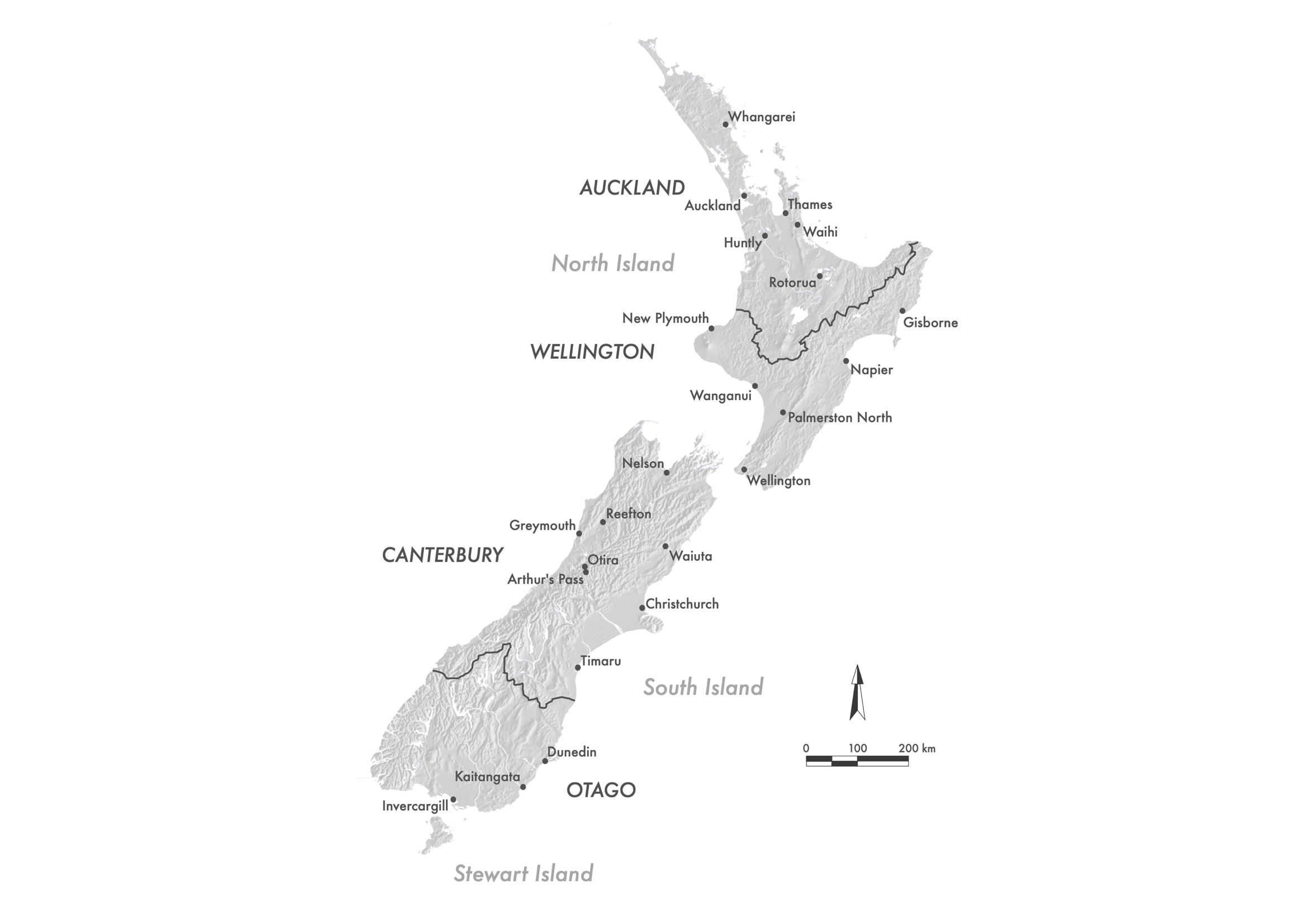
James Williamson came across the short news on page six of the New Zealand Herald, tucked between an article on aviation in the war and another marking the anniversary of the founding of Auckland, New Zealand’s most populous city, set on the isthmus of the same name in the north of the North Island.[1] Thirty-nine years old, and sporting a broad, imposing moustache, he had been living off odd jobs on building sites for more than a year. As his back trouble grew increasingly disabling, he had been forced to give up his last works. Formerly a miner, James, known to all as “Jim”, had then found work as a roadman for the small town of Mount Eden, on Auckland Bay (Map 1), where he lived with his sister. But his back pain worsened still further. Doctors diagnosed a hernia but did not consider operating. Out of work, he had tried several times to enlist in the infantry from the very beginning of the war in August 1914. Each time, the medical examination—that decisive step—sealed his fate: the condition of his back was too serious for him to be accepted into the army. Jim did not, however, give up hope of one day wearing the uniform. When recruitment for the tunnelling company was announced in mid-September 1915, he was firmly determined to go.
Jim devised a plan to get through the fateful medical examination without trouble. His sister’s neighbour was an elderly woman whose son, Peter McNab, a doctor by profession, had volunteered during the winter and was about to leave New Zealand with his unit. Having become a familiar figure in the neighbourhood since moving in with his sister, Jim had quickly struck up a friendship with Peter, who visited his mother regularly. Without hesitation, Jim asked for his help. Peter knew one of the army doctors serving at a recruiting office in Auckland. For a small sum of money, he could arrange for that doctor to examine Jim during the compulsory medical. Once the two men agreed on the amount, Peter fixed the appointment. In early October 1915, Jim duly presented himself at the Auckland recruiting centre on Rutland Street, which only a few weeks earlier had served as a training ground for military drills. The converted shed now received volunteers for the tunnelling company. Inside the building, several partitioned offices had been hastily set up. Jim was shown in to the doctor Peter had just paid off. The doctor first checked that the volunteer met the age requirements. Like most of the men enlisting for the tunnelling company, Jim was among the oldest: he was, in fact, just one year short of the maximum age limit of forty.
From the very outset, however, nobody could agree on the age limit. Some pushed for a ceiling of forty-five to capture more experienced miners; others insisted on forty for men still in good physical condition. On 16 September 1915, the Ministry of Mines urged the Minister of Defence to favour older, more seasoned recruits from the mining world.[2] Three days later, James Allen replied curtly: recruits were to be between twenty-one and forty.[3] The press, caught in the crossfire, ran two contradictory notices in the same issue—one giving forty-five,[4] the other forty.[5] By 20 September, the confusion was over: the maximum age was definitively settled at forty. The confusion of those first days resulted in the enlistment of a few men in their forties. Some volunteers, for their part, did not hesitate to give a false date of birth to cheat on their age. The most striking example was Harry Brown, a miner in Waihi, a town at the southern end of the Coromandel Peninsula in the north of the North Island. His file gave his age as an almost borderline thirty-nine. Yet the man, with his white hair,[6] was in fact fifty-eight! The recruiter had no means of uncovering the deception—especially as Harry Brown was deemed physically fit for service.
Jim Williamson also passed the medical examination successfully. As agreed, his back problems were not mentioned. Even so, the former miner was not yet certain of being accepted into the tunnellers. Recruitment for this company differed from that of the other branches of the New Zealand army. In addition to the medical, a special board—made up of a mines inspector, qualified miners and civil engineers—questioned each applicant about his mining knowledge and the skills required for the tunnellers’ future mission at the front.[7] Not just anyone could therefore be admitted. After the interview, those who failed were reassigned to other branches of the army. The aim, of course, was to ease the formation of the unit and organise its departure as quickly as possible.
The four military districts—Auckland and Wellington on the North Island, and Canterbury and Otago on the South Island—had to adapt to this unusual form of recruitment. The printed tables used to keep track of the general enlistment were altered so that they no longer matched the various military corps to which recruits were normally assigned, but instead recorded only the new tunnelling company. In the Auckland District, the columns that had previously listed recruitment for signals and infantry were crossed out and replaced with the terms “skilled”, meaning miners, and “unskilled”, denoting the rest of the recruits drawn from other trades. The government thus intended to raise 200 skilled men and 100 unskilled for the main body of the unit, while at the same time organising a first reinforcement of 100 men. It was therefore relying on the more than 6,300 miners available across the country—nearly 2,800 of them employed in gold mining—to form the tunnelling company. One week after recruitment began, almost 250 men had already been selected. The Auckland District alone approved the bulk of applications, with 142 accepted—112 skilled and 30 unskilled. Eight volunteers were even rejected for failing to meet the selection criteria or for being unfit for armed service. By contrast, the Wellington, Canterbury and Otago districts recorded only 49, 33 and 25 men accepted respectively. The government was not satisfied with these numbers, as it wanted to send the recruits to the training camp in the days that followed. This haste reflected the very difficult situation on the Western Front, where the British tunnellers were short-handed. The government therefore wanted to move as quickly as possible to form and dispatch its unit to the other side of the world. Faced with what it judged to be slow recruitment, the Minister of Defence, James Allen, intervened to resolve the problem.[8] The four military districts were instructed to provide the missing men without delay. The government imposed nothing less than quotas on its military districts. An extraordinary measure, this method of recruitment was applied only to the tunnelling company. New Zealand had previously considered introducing quotas to maintain the strength of the territorial units of its expeditionary force. However, the approach had not been adopted because of the uneven distribution of the population across the country, the growing demand for labour from industries in need, and a growing awareness of the realities of war—especially after the bloody failure of the Gallipoli landings (Turkey) on 25 April 1915, intended to seize the Dardanelles, the gateway to the Bosphorus, and secure a route to the Black Sea.[9]
Aware of the difficulties faced by certain districts—especially those on the South Island—the government asked each district to obtain additional recruits in proportion to the number of men already accepted. Otago, which had enlisted only twenty-five, was thus required to find five more skilled men and fourteen unskilled, whereas Auckland, which had already found 142, had to uncover a further fifty skilled and twenty-nine unskilled. Even with the introduction of these quotas, the Wellington, Canterbury and Otago districts struggled to reach the required figures. Otago enlisted barely six of the nineteen men expected, while Canterbury and Wellington came close to their targets, with twenty-nine and seventeen recruits respectively, instead of the thirty-three and twenty requested. The districts were required to report regularly to the Ministry of Defence on the progress of their recruiting. This information made it possible to offset shortfalls and surpluses. Once again, the Auckland District stood out by recruiting more men than necessary: it alone made up for Otago’s deficit, as well as that of the other two districts. Thanks to Auckland’s surplus, the overall strength of roughly four hundred men was maintained. The application of these quotas nevertheless remained somewhat unclear. The principle of volunteering was not called into question, and recruiters could not compel men to enlist. Even so, with pay three times higher than that of an infantry soldier, there is little doubt they had a powerful argument for drawing men into military service.
When Jim Williamson volunteered, the quotas had been in place for only a few days. The recruiting board before which applicants appeared had to lower its selection standards in order to reach the numbers required by the Ministry of Defence. It selected Jim, who obtained what he had wanted most dearly since the beginning of the war. Overjoyed, the new tunneller immediately joined his friend Peter McNab to celebrate the success of their deception over a few drinks in a local pub, already thinking of their imminent departure for Europe. Although Jim had experience as a miner, many other recruits were novices. The imposition of quotas shifted the military districts’ focus towards meeting targets rather than, as the government had originally intended, selecting skilled men. In the end, only one volunteer in two came from the mining sector, whereas Ministry of Defence projections had expected two men out of three. In practice, being a miner—or at least working in mining or excavation—no longer appeared essential. Half of the tunnellers came from trades with no obvious connection to underground work: farmers, labourers, office clerks, tram drivers, butchers, hotelkeepers, firefighters, bushmen, and dockers. Most brought at least the capacity for hard physical labour; a handful remained harder to explain—not least the owner of a billiard saloon and a travelling showman. A few, however, would prove genuinely useful.
Despite their very small numbers, engineers were no less essential to future operations at the front—particularly for analysing the subsoil and overseeing tunnel construction. This was all the more true because, among the roughly twenty recruits from this field who enlisted in September and October 1915, some had already followed outstanding professional paths. At thirty-five, Hugh Vickerman already held a highly responsible post. As assistant to the Engineer-in-Chief of New Zealand’s Ministry of Public Works, he oversaw the study, design and construction of public civil and marine infrastructure throughout the Dominion.[10] He had entered the Ministry in 1901, shaped early on by the guidance of engineers Hay and Holmes, while completing his studies in Auckland—then worked his way from assistant engineer on the Midland Railway to the department’s Wellington headquarters after passing his associate membership examination.[11] A Bachelor of Science came in 1909; a master’s degree in 1914.[12] Along the way he had designed railways, tunnels, bridges and viaducts, overseen road modernisation and heritage renovation in the Canterbury District, and even developed a hydroelectric power station on Lake Coleridge. By 1913, he was deputy head of the Ministry of Public Works. These credentials, built across a career devoted to shaping the Dominion’s infrastructure, earned him the rank of captain when the tunnelling company was formed—the second-highest after the major who commanded the unit.
Not all of the engineer recruits, however, had such broad training, and some possessed advanced specialisations—most logically and predominantly in mining engineering. James Oliver Campbell Neill began his career in much the same way as Hugh Vickerman, with an engineering education. Early on, he chose to specialise in mining engineering and attended the Otago School of Mines on the South Island, where he earned an associate diploma.[13] Neill first worked in New Zealand’s mines before leaving for the United States. Shortly before the outbreak of war, he returned to the Dominion.[14] When recruitment for the main body and the 1st Reinforcement of the tunnelling company began in mid-September 1915, he enlisted. Like Hugh Vickerman, Neill entered the unit with an officer’s rank and was commissioned as a second lieutenant.
Other trades—particularly from the building and construction sectors, skilled crafts, the timber industry and public works—provided recruits whose experience could prove necessary in underground warfare. Surveyors and land measurers, for instance, could help engineers draw up tunnel plans and drive the galleries in the right directions. Sawyers, sawmill workers and carpenters brought the know-how needed to build the timber sets that supported tunnels as they were being dug. Roadmen could assist the miners with excavation, while drainers, plumbers and pipefitters would, if required, help remove water from below ground. When the time came, experienced or not, all of them would have to carry out their mission.
In the first days of October 1915, George Race received his call-up to report to the tunnellers’ training camp at Avondale, near Auckland. He was living at the Martha Villa boarding house in the centre of Waihi, a town of more than six thousand inhabitants, 140 kilometres south-east of Auckland, at the south-eastern end of the Coromandel Peninsula—a strip of land projecting into the Pacific Ocean, framed by the Hauraki Gulf to the west and the Bay of Plenty to the east (Map 1). George had enlisted a few days after the announcement of the unit’s creation and had been declared physically fit for armed service on 22 September 1915. Unmarried, like most of the tunnelling company’s recruits, he was a gold miner in the heart of a region where gold sustained tens of thousands of people. Employed by the Waihi Grand Junction Gold Mining Company—the town’s second-largest concern after the Waihi Gold Mining Company—his work was to drive extraction galleries beneath the town itself. Underground, George never saw gold. The precious metal lay as dust within the veins, and few people had access to the final stages of processing: those who recovered the particles and smelted them into ingots. An unavoidable part of each working day, George took the cage into and out of the mine with Gerald Punch and the rest of their gang. Once they reached their level, the miners made their way into the various extraction galleries, which ran along—or parallel to—a quartz vein, the main indicator of a gold deposit. The tunnels were therefore driven on several levels in order to reach the lode. When they arrived at their heading, George and Gerald set to work at once. Excavation was carried out with pneumatic drills and explosive charges—the only way to break Waihi’s very hard rock.[15] Like all mine workers, the men were paid by the number of metres driven. A bonus was awarded for every extra ton of ore hauled to the surface.[16] Working conditions underground did not make their task any easier: the tunnels were constantly wet, the heat oppressive, and the air hard to breathe. After eight hours’ work, George and Gerald came back up, to be replaced below by the next shift. Above ground, George’s team took advantage of a good hot shower. Once they had scrubbed clean, they washed their work clothes. At the end of this unchanging ritual, they headed home. Newly arrived in Waihi in search of work, George lived in a boarding house on Seddon Street. He quickly struck up a friendship with Gerald Punch, an Australian who had come to try his luck in New Zealand. After a day’s work, the two men would usually meet over a “home brew”. Alcohol—blamed for the woes of many towns—had been prohibited across the region in 1908. That did not, however, stop some pitmates from secretly brewing their own beer. Drinking it had to be done in strict secrecy, so as not to attract the attention of the police, who did not hesitate to carry out raids.[17] Typically, when work stopped on Saturday evening, many Waihi miners would take the road to Hikutaia, the nearest town outside the Ohinemuri district where alcohol was permitted, and spend their evenings drinking themselves senseless.
It scarcely matters whether it was George or Gerald who first learned of the recruitment drive for the tunnelling company launched in mid-September 1915. As miners, the two men probably felt more directly concerned than others by the formation of this special unit. The news spread quickly through the town: men who had read the notices in the newspapers told those who had not yet heard, and the talk gathered pace when the first volunteers announced their enlistment to their workmates. George was thinking of signing up, but his pitmates seemed more hesitant. Many simply did not want to go. Gerald followed his friend, and together they added their names to the list of tunnelling recruits at the end of September 1915. On 6 October, George, Gerald and eleven other miners from the Grand Junction mine—closely followed by nearly thirty men from the Martha mine, run by the Waihi Gold Mining Company—took the train to Avondale to begin their initial military training. These recruits were, quite simply, the largest single group of volunteers from the mining sector. While nothing similar appeared among other professions, several other clusters of workmates from across the Dominion’s gold and coal communities also left together for war. After Waihi, the workings that supplied groups of men to the company were located on the South Island. Thus, in the Canterbury District, the town of Waiuta brought together around fifteen recruits, all employed at the Blackwater mine. On the West Coast, the town of Reefton provided most of the men from the centre of the region, many working for the Keep-it-Dark Mining Company and the Globe Hill mine, while farther south it was recruits from smaller workings at Otira and Arthur’s Pass who predominated. The New Zealand Coal and Oil Company, based at Kaitangata, provided around twenty men, while farther north a few workers came from more modest mines, notably in and around Dunedin, at Roslyn and Caversham (Map 1).
Up to 10 October, recruits from across New Zealand arrived at Avondale little by little. Jim Williamson reached the camp on 8 October, after reporting that morning to the sergeant-major at Auckland’s military drill ground. Twenty-five other men had already assembled there. The group marched in ranks to the station, where a train carried them a few kilometres outside Auckland. During the short journey, Jim made the acquaintance of the man seated beside him: a thirty-year-old public works labourer, Harold Howard, known as “Lofty”. The two recruits took to each other at once and were soon inseparable.
The tunnellers’ camp was not inside a military compound but was set up on a horse-racing course, close to the Auckland–Kaipara railway line. Training should have taken place at Trentham Military Camp, near Wellington, in the south of the North Island. The Ministry of Defence nevertheless changed its plans when the introduction of quotas showed that the majority of volunteers would come from Auckland and its surroundings, and from the district as a whole. It thus spared itself unnecessary transport costs to Wellington when more than one man in two was already near Auckland. As early as 20 September, the Avondale Jockey Club offered its facilities to the local military authorities.[18] The offer, though accepted, was not put into effect by the end of September, so that many tunnellers received call-up notices stating that they were to depart in early October for Trentham Camp. At the very beginning of October, the army appears to have formally requisitioned the racecourse. The tunnelling company was not the only New Zealand unit to take its first steps on a non-military—and decidedly unconventional—site. The army grew used to using racecourses. As early as 1914, the 3rd Field Company of Engineers had been mobilised at Awapuni Racecourse in Palmerston North, north of Wellington.[19] More specifically, Avondale Racecourse had hosted, a year before the tunnellers, the Māori contingent for its training between 17 October 1914 and 10 February 1915.[20]
Arriving shortly before midday, Williamson’s group was directed to the canteen. Jim, Lofty and the others then reported to the camp commandant, Major Newcombe. After signing their attestation to serve in the expeditionary force, they were issued with a kitbag and their personal military effects. Assigned to the same section of around twenty men, Jim and Lofty shared a tent with six of their comrades. Some fifty tents stood side by side in the centre of the racecourse, inside the circuit of the track, while the club buildings were set aside for the day-to-day running of the camp.[21] Some, like Jim and Lofty, began getting to know their tentmates. Conversation was lively and good humour reigned. Nicknames—so beloved in New Zealand—flew thick and fast. Jim was given the sobriquet “Dad”, after advising Lofty not to get too friendly with a fellow who struck him as no good.[22] Others, like George Race and Gerald Punch, already settled in, were busy with daily duties. Entering the military world meant a clean break with the routines of everyday life: the volunteers were now confined within an enclosed perimeter and were no longer allowed to leave without permission.
In the days that followed, new recruits arrived. Like Jim, Lofty, George and Gerald, they all shared one characteristic: they were of European origin. The company appears not to have enlisted any Māori, the Indigenous people who formed a substantial part of New Zealand’s population.[23] Māori volunteers were grouped into a separate contingent, formed only after difficult negotiations with London, which did not wish to see Indigenous troops involved in a war between Europeans. A segregated force by design, it nonetheless carried a pragmatic argument: the deeds of an entire Māori unit could be recognised far more visibly across New Zealand than those of individual soldiers scattered among European companies. Voices were raised against the creation of this contingent, among Māori and Europeans alike. Worse still, General Godley, commander of the New Zealand Expeditionary Force, remained doubtful about the usefulness of such a unit and questioned the need for it. Some Māori tribes that had resisted European encroachment in the second half of the nineteenth century were adamantly opposed to enlisting. They would remain opposed to going to fight and would even refuse conscription in September 1916. Others, by contrast, set aside their differences with the British to fight a common enemy. The Arawa, Ngāti Porou, Ngāti Kahungunu and Ngā Puhi tribes wanted to prove to the whole country that they were full New Zealand citizens, sharing the same history—and defending it together. The government thus came to present two types of combatant: the Māori and the Anglo-Saxon.
Outside their own contingent, Māori did not serve in other military units, which were composed exclusively of Europeans. All the tunnellers, whether born in New Zealand or not, were products of immigration. Immigrants themselves—or the children, or even grandchildren, of immigrants—each had, through their family history, roots in countries outside New Zealand. The volunteers of the tunnelling company were fairly representative of New Zealand society in the first quarter of the twentieth century, when natural population growth was beginning to outstrip immigration.[24] Thus, 54% of the tunnellers had been born on New Zealand soil, while immigrants still made up 46% of the unit. The great majority of the Anglo-Saxon recruits came chiefly from England, Scotland and Ireland, through several waves of immigration—from the arrival of the first settlers in the mid-nineteenth century to the landing of new arrivals on the eve of the Great War. These immigrants brought with them their customs and religious denominations, contributing to the Dominion’s rich cultural mix. From the moment they enlisted, however, such origins no longer mattered. The tunnellers were no longer defined by their personal journeys, but by the uniform they wore, the country they defended, and the unit they served.
At Avondale Racecourse, new recruits continued to pour in until the evening of Sunday, 10 October. In one of the newly arrived groups, Jim was astonished to discover his brother, George Williamson, whom he had not seen for some time. The two men were not the only members of a sibling pair: the company’s ranks included around a dozen such sets. The largest was the Henriksen trio—Percy, the eldest, Henry, and Christen, the youngest. Unlike Jim and his brother, the Henriksen brothers, like most of the others, had volunteered on the same day. Remarkably, a father, William Worth, and his son Ernest, who had enlisted separately, also found themselves reunited at the training camp.
On Monday, 11 October, at first light, more than four hundred tunnellers were assembled for the first time on the racecourse. Most of them were not boys playing at war, but mature men, with hardened hands and faces.[25] Only a handful had already experienced military life, having served in the South African War (1899–1902), a conflict that took shape at the end of the nineteenth century after the discovery of gold in the Transvaal region of South Africa. The ensuing rush brought its share of British settlers, and rivalries gradually flared with the “Boers”—a term derived from the Afrikaans word for farmer, used to designate South African peoples whose origins could be traced back to Dutch, German and French Huguenot settlers established after 1662 near the Cape of Good Hope.[26] The imperial army took up positions on the Transvaal border as reinforcements from overseas began to land in South Africa. On 9 October 1899, the Transvaal government issued an ultimatum to the British, demanding the withdrawal of their troops.[27] The British ignored the demand. The Transvaal allied itself with the Orange Free State and declared war on 12 October. New Zealand, however, did not wait for the ultimatum to support the Empire. Thus, as early as 28 September 1899, the New Zealand Prime Minister, Richard Seddon, sought the approval of the House of Representatives to raise and, if necessary, send a contingent of two hundred mounted men to South Africa. Seddon believed he could intimidate the Boers by demonstrating the solidarity that bound the colonies to the Empire.[28] Above all, he enjoyed the backing of the entire population: volunteers almost jostled one another to enlist. The New Zealand force would earn a strong reputation, and losses were few. For the first time, the nickname “Kiwi”—after the flightless bird endemic to the country—was used to refer to New Zealand soldiers.[29] The Kiwis established themselves as excellent troops. New Zealanders found, above all, a shared identity in wearing the uniform, adorned with the fern-leaf badge, a plant characteristic of the bush. Yet this reputation did not describe the men who had joined the tunnelling company, who were strangers to the military world. More than one tunneller in two was already past thirty, and few of them had been able to benefit from the territorial system—the military reserve—whose upper age limit for enlistment had been set at thirty. Even so, these recruits would soon have to cut a good figure if they were to uphold the ideal of the virile, strong New Zealand soldier.
The first weeks at Avondale were hard. The men were woken at six o’clock, followed by a run of nearly two kilometres, at a brisk pace, around the track. Unaccustomed to such exertion, Jim was already struggling after a few hundred metres. He had to stop several times to catch his breath while Lofty—almost out of breath himself—urged him on.[30] The same physical drills were repeated every day as military instruction began. Training started with the basics: standing to attention, the military salute, and holding one’s place in the ranks. For two weeks, the emphasis was on the first lessons in close-order drill—that is, forming men up in ranks and files and carrying out movements together, first on the spot and then on the march. Close-order drill was the foundation of all military training, whatever the branch. The instructors took a certain pleasure in making the men repeat the same motions again and again. The aim was to instil discipline: to enforce commands, to obey without thinking, and to achieve a smooth, unified flow in every movement. Each day, the instructors’ orders rang out around the racecourse. In groups of about twenty, the tunnellers learned to march in single file, then two abreast. Jim was not very good at keeping step, while Lofty seemed more at ease. Without warning, an instructor bellowed the order to fall in, and Jim’s group hurried into position. Another shout rang out and the men snapped to attention—chests out, arms straight down their sides, heads high and still. Attention and stand-at-ease followed in quick succession. At the next command, Jim, Lofty and the others found themselves marching again. Drill also served to tighten the bonds between the men and foster a spirit of unity. For some of Jim’s comrades, this routine was not easy to endure. They did not hesitate to slip out of camp at nightfall for a little fun in Auckland, but above all to break up the boredom of daily life. A few managed to evade the guards’ vigilance, but many more were caught and disciplined. Others were tracked down by instructors sent out to hunt for the absentees. In civilian life, miners were used to acting as they pleased once work ended, and had to be handled with tact—and with a wider margin of freedom—than in any other corps.[31]
All the more so because the tunnelling company’s distinctive recruitment—drawn not only from miners but, more broadly, from the working world—brought together men with strong social demands. The recruits at Avondale came from a society in which trade unions—associations bringing together men of the same trade or class, formed to defend common professional interests—were among the most numerous in the world. The gathering of tunnellers was soon publicly nicknamed the “Red Federation”, the familiar name given to a union organisation with rather radical ideas: the New Zealand Federation of Labour. By 1915 this movement had all but disappeared, yet it had once brought together more than a quarter of the country’s working-class unions, including virtually all miners’ organisations.[32] It had left a clear mark on attitudes by taking part in, and supporting, several major strikes at a time when the right to stop work was almost prohibited. In 1913, the Red Federation attempted a national union with the more moderate branches of the New Zealand left, structured around a political body—the Social Democratic Party—and a trade-union body, the United Federation of Labour.[33] Imperfect and fragile, the alliance soon broke apart again by the end of 1913, divided between the men of action who sought the end of capitalism through forceful measures and the men of ideas who campaigned for the creation of a genuine workers’ politics.
A fervent defender of the labour movement and politically active for several years on the South Island, John Edward McManus was the company’s best-known representative of the radical left. It was he, moreover, who first applied the nickname “Red Federation” to the tunnellers—a label later taken up by the press. Going beyond the ordinary rank-and-file militants, McManus claimed that the unit contained around ten former secretaries and more than forty former members of executive committees from various unions that had rallied under the banner of the Red Federation between 1909 and 1913.[34] He was, in fact, virtually the only one to speak of such a labour presence. One of the few newspapers to take an interest in the subject was the Grey River Argus, a daily published in Greymouth, a town on the West Coast of the South Island. It was also almost alone in printing several reports whose political slant was easy to discern—no surprise, since the paper had been owned by the moderate left since 1913.[35] The presence of tunnellers linked to the Red Federation offered an opportunity to highlight working-class activism in September 1915, at a moment when the left in Parliament was rallying against the introduction of conscription.[36] The tunnelling company did indeed include trade unionists—perhaps not as many as McManus suggested—although working-class occupations made up a large majority of the recruits. By associating the tunnellers with the image of the Red Federation, the New Zealand left gave particular weight to the message it wished to send to the government: it wanted to prove that working people had the courage to volunteer, even after more than a year of war, and that conscription was a solution it considered morally humiliating.
It was not, however, for their courage in volunteering that the people of Avondale would remember the tunnellers. After four weeks of training, Jim, Lofty, George, Gerald and their comrades were granted seven days’ leave, from 8 to 14 November. The week gave the tunnellers a chance to say goodbye to their loved ones, signalling that their departure for Europe was close. Yet this interruption in training created an embarrassing situation for the military authorities. The exuberance of many tunnellers on their return from leave left an unforgettable impression on the residents of Avondale’s main street leading to the racecourse. The men arrived in the township utterly drunk—so much so that the military authorities were obliged to fetch them and transport them back to camp.[37] The parade of staggering men, bawling songs and shouting at the top of their lungs, chilled the townspeople, who had not expected to find themselves hosting such a gang of drunkards. Within hours, the tunnellers’ antics were the talk of the town and soon spread beyond it. Jim was mortified by the damage this image did to the company. He did not hesitate to write in his memoirs: “…the people of Auckland were truly ashamed of us.”[38] From then on, locals avoided going anywhere near the racecourse—along with the Jockey Club authorities and the town council. The tunnellers were left to themselves, living almost in isolation. They received neither gifts nor any other sign of interest. Evenings in camp were bleak, and the men had to provide their own entertainment. No band played for them; no diversions were arranged.[39] The tunnellers could rely only on one another. They alone were responsible for forging a unit worthy of their countrymen who had already gone to war.
Chapter 2
Forging Good SoldiersNotes
- 1.
Imperial War Museum, Documents.11515, The First World War Memoirs of James Williamson, Part 1, f° 1.
- 2.
Te Rua Mahara o te Kāwanatanga Archives New Zealand, AD 1 Box 1348 62/23, Formation of Corps - Tunnelling Company - Formation of for service abroad, 1914-1915. Letter from the Minister of Mines to the Minister of Defence, 16 September 1915.
- 3.
Ibid., Letter from the Minister of Defence to the Minister of Mines, 19 September 1915.
- 4.
Evening Post, 20 September 1915, p. 2.
- 5.
Ibid., p. 8.
- 6.
Te Rua Mahara o te Kāwanatanga Archives New Zealand, AABK W5530 5/0018922, Military Personnel Files of Harry Brown – WWI 4/1602.
- 7.
James Campbell Neill, The New Zealand Tunnelling Company, 1915-1919, Auckland, Whitcombe & Tombs, 1922, p. 3.
- 8.
Evening Post, 29 September 1915, p. 7, “We want seventy-seven more trained men for the Engineering Tunnelling Corps […] and eightly-four other men not so skilled, to complete the corps. We want these men at once, so they can go into camp in a few day's time […] there could be no delay if we were to carry out our obligations.”
- 9.
Christopher Pugsley, On the Fringe of Hell, New Zealanders and Military Discipline in the First World War, Auckland, Hodder & Stoughton, 1991, p. 224.
- 10.
[Anonymous], “Obituary Hugh Vickerman, 1880-1960”, ICE Proceedings, vol. 22, n°2, 1962, p. 255.
- 11.
Ibid.
- 12.
Ibid.
- 13.
[Anonyme], “Mr J.O.C. Neill, BSc. (First President of NZMS)” [Online]. New Zealand Microbiological Society [Accessed on 29 August 2011].
- 14.
Ibid.
- 15.
James Bert McAra, Gold Mining at Waihi, 1878-1952, Waihi Martha Press, 1988 (orig. ed. 1978), p. 187.
- 16.
Ibid.
- 17.
Ibid., p. 268.
- 18.
Evening Post, 21 September 1915, p. 2, “The whole of the buildings and grounds have been placed at the disposal of the local military authorities by the Avondale Jockey Club, and subject to approval of Major Talbot, P.M.O., the offer will be accepted.”
- 19.
Norman Annabell, Official history of the New Zealand Engineers during the Great War 1914-1919, Wanganui, Evans, Cobb & Sharpe Limited, 1927, p. 2.
- 20.
Christopher Pugsley, Te Hokowhitu A Tu, The Maori Pioneer Battalion in the First World War, Auckland, Reed Books, 1994, p. 23-30.
- 21.
Imperial War Museum, Documents.11515, The Memoirs of James Williamson…, op. cit., Part 1, f° 2, “… we were marched off the tent on the Avondale Racecourse, not far from where one of the steeplechase jumps used to be […] The routine at Avondale was I suppose the same as it is done in most military camps with new recruits.”
- 22.
Ibid., Part 1, f° 7.
- 23.
The second people, a minority, are the Moriori, who live in the Chatham Islands—New Zealand islands about 800 kilometres east of New Zealand’s South Island—whose arrival predates that of the Māori. For more information, see Michael King, Moriori: a people rediscovered, Auckland, Viking, 2000 (orig. ed. 1989).
- 24.
Georges-Goulven Le Cam, L’Australie et la Nouvelle-Zélande, Rennes, Presses universitaires de Rennes, 1996, p. 97.
- 25.
James Campbell Neill, The New Zealand Tunnelling Company…, op. cit., p. 4.
- 26.
Paul Coquerel, L’Afrique du Sud des Afrikaners, Bruxelles, Éditions Complexe, 1992, p. 21.
- 27.
Ibid., p. 372.
- 28.
W. David McIntyre, « Imperialism and Nationalism », in The Oxford History of New Zealand, edited by Geoffrey Rice, Auckland, Oxford University Press, 1997 (orig. ed. 1992), p. 308.
- 29.
Ibid., p. 342.
- 30.
Imperial War Museum, Documents.11515, The Memoirs of James Williamson…, op. cit., Part 1, f° 3.
- 31.
Military Engineering: Demolitions and Mining, London, War Office, 1923, p. 127.
- 32.
Barry Gustafson, Labour’s Path to Political Independance: The Origins and Establishment of the New Zealand Labour Party 1900-19, Auckland, Auckland University Press, 1980, p. 30.
- 33.
Ibid., p. 67.
- 34.
Grey River Argus, 10 December 1915, p. 2, “There are at present in camp with this company eleven members who were formerly secretaries of various trade unions, while there are over forty who are erstwhile members of trade union committees.”
- 35.
Barry Gustafson, Labour’s Path to Political Independance…, op. cit., p. 86.
- 36.
Ibid., p. 108.
- 37.
Te Rua Mahara o te Kāwanatanga Archives New Zealand, AD 1 Box 1072 39/172, Training reports from Avondale Camp, 1915. Training report for the week of 23–30 October 1915, “The men have settled down to discipline much better than was anticipated, considering the fact that on arrival a great many of them had to be carried from the Railway Station into Camp, being in a helpless drunken condition”
- 38.
Imperial War Museum, Documents.11515, The Memoirs of James Williamson…, op. cit., Part 1, f° 4.
- 39.
Ibid., Part 1, f° 8.
How to cite this page
Anthony Byledbal, “Chapter 1: The Tunnellers from the Antipodes”, in Kiwis Dig Tunnels Too, New Zealand Tunnellers, 2017. Available at: